
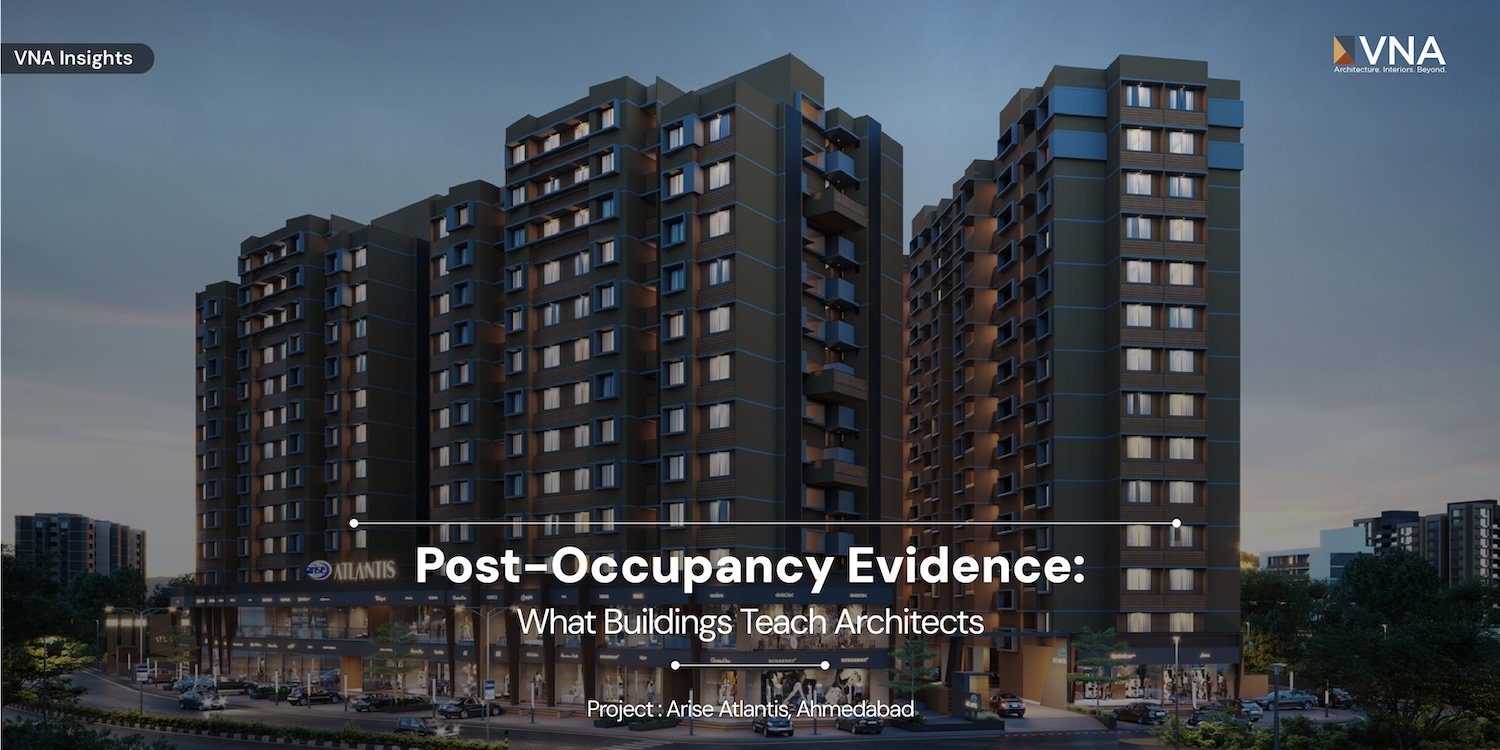
Most architecture stops at handover. The building is complete, the photographs are taken, the project is published—and the architect moves on. But handover is not the end. It is the beginning of the building’s real life: occupied, used, tested by climate and time. This note is about post-occupancy evidence—what buildings actually teach architects after people move in, and why this feedback loop matters more than any projected performance claim.
When an architect presents a design, they show renders, drawings, and performance projections. The building will be comfortable. The energy use will be low. The spaces will work as intended.
But projections are not evidence.
Evidence comes later—after the building has been occupied for a year, two years, five years. After it has faced summer and monsoon, maintenance and modification, the unpredictable ways that people actually use spaces.
The question is: do architects go back and check?
What is post-occupancy evaluation—and why is it rare?
Post-occupancy evaluation (POE) is the systematic study of how buildings perform after occupation. It includes physical performance: Is the building comfortable? Is energy use as predicted? Are systems working correctly? Do materials hold up?
It also includes user experience: Are the spaces being used as intended? What works well? What do occupants struggle with? What would they change?
POE is standard practice in some countries and sectors—particularly in healthcare and education, where building performance directly affects outcomes. But in general architectural practice, it is rare.
The reasons are practical: projects end at handover, fees are exhausted, clients move on, and architects are already absorbed in the next project. There is no built-in incentive to go back.
But the cost of not going back is high: architects repeat the same mistakes, performance claims remain untested, and the gap between intention and reality stays invisible.
What do buildings teach that drawings cannot?
Drawings show intent. Occupied buildings show consequence.
Thermal performance. A room designed to be cool may overheat because of unanticipated sun angles, inadequate shading, or thermal bridges. Only occupation reveals whether comfort predictions were accurate.
User behaviour. Architects design for how they imagine spaces will be used. Occupants use spaces in their own ways—rearranging furniture, blocking ventilation, adding loads. Understanding this gap improves future designs.
Material durability. Finishes that look good at handover may stain, crack, or wear poorly. Knowing how materials age in actual conditions informs better specification.
Maintenance realities. Details that are elegant on paper may be impossible to maintain. Access panels that cannot be reached, surfaces that cannot be cleaned, systems that require specialist service—these problems only emerge in operation.
Operational energy. Simulated energy use and actual energy use often diverge. The building may perform better or worse than predicted—and understanding why is essential for improving design practice.
What has VNA learned from going back to completed projects?
At VNA, we have made post-occupancy review a practice—returning to completed projects after one, two, or more years to see how they actually perform.
From RTC SPIPA in Mehsana, we learned how institutional buildings hold up under intensive use, how passive strategies perform in hot-dry conditions, and how maintenance practices affect longevity.
This feedback is not comfortable. It often reveals gaps between intention and reality. But it is the only way to improve.
Why should clients care about post-occupancy evidence?
When evaluating an architecture firm, clients typically look at portfolios: photographs of completed projects, often taken immediately after handover, styled for publication.
This is useful but incomplete. A photograph does not tell you whether the building is comfortable in May, whether the materials have held up, whether the spaces work as intended.
Post-occupancy evidence—from the firm’s own projects, documented honestly—is a stronger indicator of design quality than any portfolio image.
Ask: Can you tell me how your completed projects have performed after two years? What did you learn? What would you do differently? A firm that can answer these questions has a feedback loop. A firm that cannot is designing in the dark.
What questions should post-occupancy reviews answer?
Physical performance: Is thermal comfort as expected? Is energy use as predicted? Are there maintenance issues? How have materials aged?
User experience: Do occupants find the spaces functional? Are there patterns of complaint? How are spaces being used versus how they were designed?
Operational reality: Is the building easy to maintain? Are systems working correctly? What modifications have occupants made, and why?
Design lessons: What worked better than expected? What worked worse? What would we do differently next time?
How does post-occupancy evidence change design practice?
When architects know they will return to evaluate performance, they design differently. Decisions become more accountable. Claims become more realistic. Comfort, durability, and maintainability move from abstract values to concrete priorities.
Over time, a practice that systematically learns from its buildings develops real expertise—not just theoretical knowledge, but tested understanding of what works in actual conditions.
This connects to what I wrote in Issue 8: green building certification tells you what was designed. Post-occupancy evidence tells you what was built—and whether it works.
The deeper point: evidence beats intention
At VNA, we believe that architecture should be accountable to its outcomes, not just its intentions. A beautiful building that overheats is a failure. A modest building that performs well is a success.
Post-occupancy evidence is how we hold ourselves to that standard. It is uncomfortable, sometimes humbling, but it is the only honest measure of whether we are doing our job.
The buildings are the test. And the test continues long after the architect has moved on.
In the next note, I’ll apply this principle to a specific project: RTC SPIPA in Mehsana—the constraints we faced, the decisions we made, and what the building has taught us since occupation.
— Ar. Brijesh Patel
Founder & Principal Architect, VastuNirman Architects (VNA)