
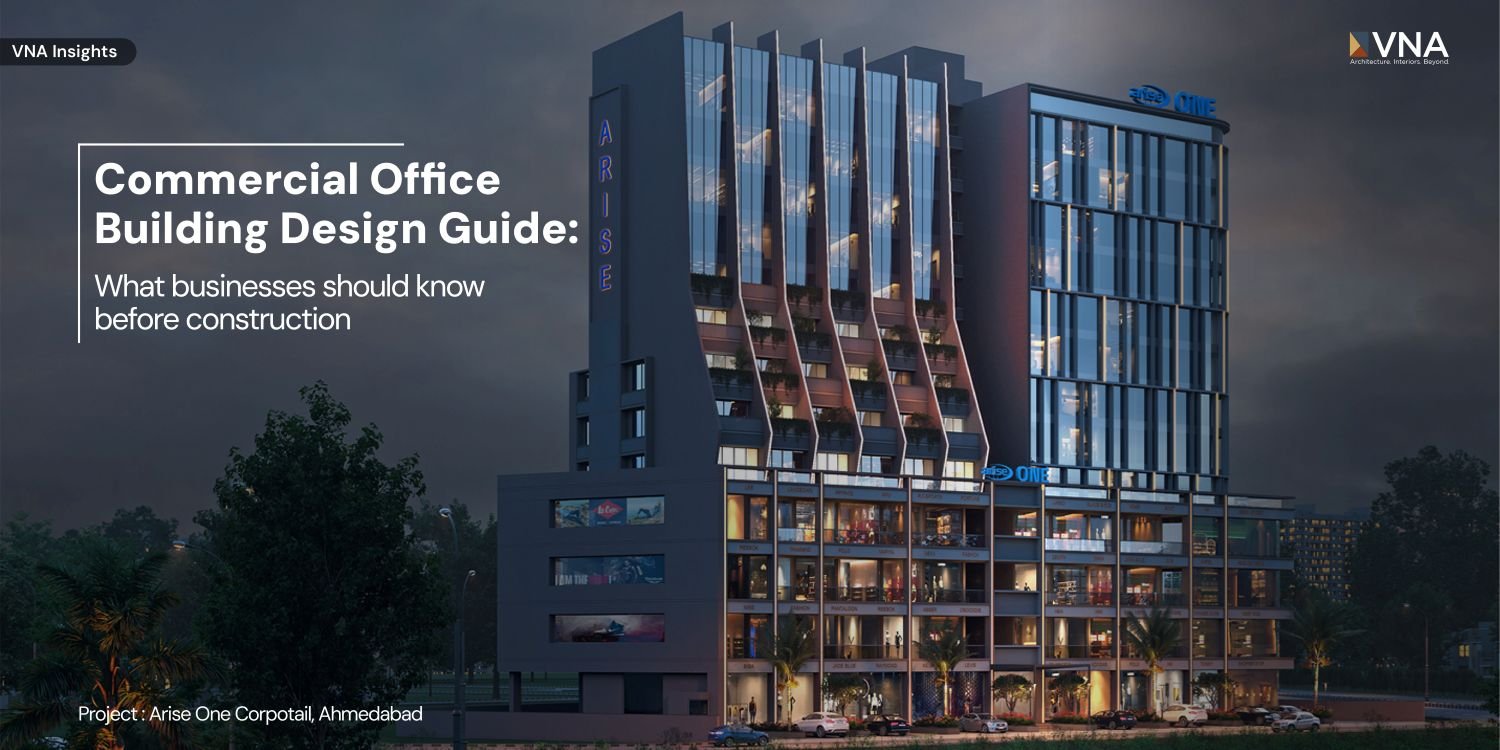
Commercial office buildings are often commissioned by people whose expertise is business rather than building design. This is natural—construction is not their expertise, and when business thinking and building thinking are not aligned, it can create expensive mistakes: briefs that don’t match budgets, designs that don’t match operations, and buildings that look impressive but work poorly. This note is a guide for business owners and decision-makers approaching office building design—not to make them architects, but to help them ask better questions before construction begins.
When someone searches for a “commercial building architect,” they are usually at the beginning of a process they don’t fully understand. They know they need a building. They may have a site, a budget, a timeline. But they often haven’t thought through the operational questions that will determine whether the building succeeds.
The best time to think about these questions is before design begins. Once construction starts, changing course becomes expensive.
What is the building actually for, and who will use it?
This sounds obvious. In practice, it rarely is.
“We need an office building” is not a brief. A brief requires clarity: Is this for your own company, or for lease to tenants? If tenants, what kind—startups, corporates, professional services? What floor plates do they need? What amenities? What parking ratio?
If owner-occupied, how does your organisation work? Open plan or cabins? Collaborative or focused? Growing or stable? How might needs change in five or ten years?
This connects to what I wrote in Issue 2: commercial buildings are built around systems. The system must be defined before the building can be designed.
How do you translate business requirements into an architectural brief?
Business owners think in terms of headcount, departments, and growth projections. Architects think in terms of area, circulation, and spatial relationships. The translation between these languages is critical.
A good architect will help with this translation, asking questions about workflow, hierarchy, visitor experience, and operational needs. But the client must be prepared to engage. The more clearly you can articulate how your business works, the better the building will support it.
What does the site allow, and constrain?
Every site comes with rules: setbacks, FSI limits, height restrictions, parking requirements, fire access, utility connections. These are not obstacles to creativity. They are the frame within which design happens.
Before committing to a site, understand what it permits. A “cheap” site with restrictive regulations may cost more to develop than an “expensive” site with better potential.
Also consider context: access roads, visibility, neighbouring buildings, future development patterns. A commercial building is not an island. In Ahmedabad, established corridors like SG Highway and Prahlad Nagar carry specific tenant expectations—parking ratios, floor plate sizes, amenity standards—that a well-briefed architect will factor in from the start.
Why must operations be designed before aesthetics?
Commercial buildings fail when operations are treated as afterthoughts.
Where do cars enter and exit? Where do service vehicles go—deliveries, garbage, maintenance? Where is the main entry, and how does it relate to parking? How do people move vertically, and how many lifts are needed? Where are the toilets, pantries, electrical rooms, server rooms? How will the building be cleaned, maintained, secured?
These questions are not glamorous. But if they are not resolved in design, they will be resolved in operation—badly, expensively, and permanently.
The best commercial buildings feel effortless because the operations are invisible. That invisibility is designed.
How should you think about floor plate efficiency?
In commercial buildings, floor plate efficiency—the ratio of usable area to total area—directly affects value. Every square foot spent on lobbies, corridors, and service areas is a square foot not earning rent or housing staff.
But efficiency is not just about minimising circulation. It is about right-sizing: enough core area to serve the floor, but not more; corridors wide enough for comfortable movement, but not wasteful; toilets and services located for convenience without fragmenting usable space.
An experienced commercial architect understands these trade-offs. Ask to see floor plate analyses from previous projects.
What building systems require early decisions?
Commercial buildings are systems buildings. HVAC, electrical, plumbing, fire protection, IT infrastructure—these are not added after architecture is finished. They are coordinated with it from the start.
Early decisions include: Will the building be centrally air-conditioned or will tenants have independent systems? What electrical load is required, and is there backup power? Where do risers and shafts go, and are they sized for future capacity? What fire protection systems are required, and how do they affect ceiling heights and layouts?
If these are decided late, they constrain design. If they are decided early, design can accommodate them elegantly.
How do façade decisions affect long-term cost?
A commercial façade is not just image. It is operating cost.
This connects to Issue 5: the façade decides energy behaviour before HVAC begins. A fully glazed west façade in Gujarat will increase cooling loads significantly. That cost recurs every month, forever.
Similarly, façade materials that stain, fade, or require frequent cleaning become maintenance burdens. The cheapest façade to build is often not the cheapest to own.
What approvals and compliance requirements apply?
Commercial buildings face more regulatory scrutiny than residential: development permissions, environmental clearances, fire NOCs, accessibility compliance, and more. The approval process takes time and requires documentation.
An experienced architect navigates this process as part of design, not as a separate hurdle. Ask about their track record with approvals in your jurisdiction.
How should you structure the project team?
A commercial building requires coordination among many consultants: architect, structural engineer, MEP engineers, façade consultant, landscape architect, interior designer, and often specialists for fire, acoustics, and vertical transportation.
The architect typically leads this team, but the client must understand who is responsible for what. Clear contracts, defined deliverables, and regular coordination meetings prevent gaps and conflicts.
What questions should you ask before selecting an architect?
Ask about experience: not just “have you done commercial buildings” but “have you done buildings of this type, scale, and context?” Ask to visit completed projects and speak with the owners or facility managers.
Ask about process: how do you handle brief development, cost estimation, approvals, and construction supervision? What are the deliverables at each stage?
And ask about operations: how do you ensure that the building works, not just looks? What decisions do you make early to prevent problems later?
The deeper point: a commercial building is a business decision
At VNA, we approach commercial projects as business problems that require architectural solutions. The building must perform: for the owner, for tenants or staff, for the balance sheet.
Design excellence matters. But design excellence that ignores operations, efficiency, and lifecycle cost is not excellence. It is expensive art.
The best commercial buildings are the ones where business thinking and architectural thinking have been integrated from day one.
In the next note, I’ll shift from commercial to residential—but with a different focus: how technology is transforming luxury home interiors, and what “smart” should actually mean in a well-designed home.
— Ar. Brijesh Patel
Founder & Principal Architect, VastuNirman Architects (VNA)