
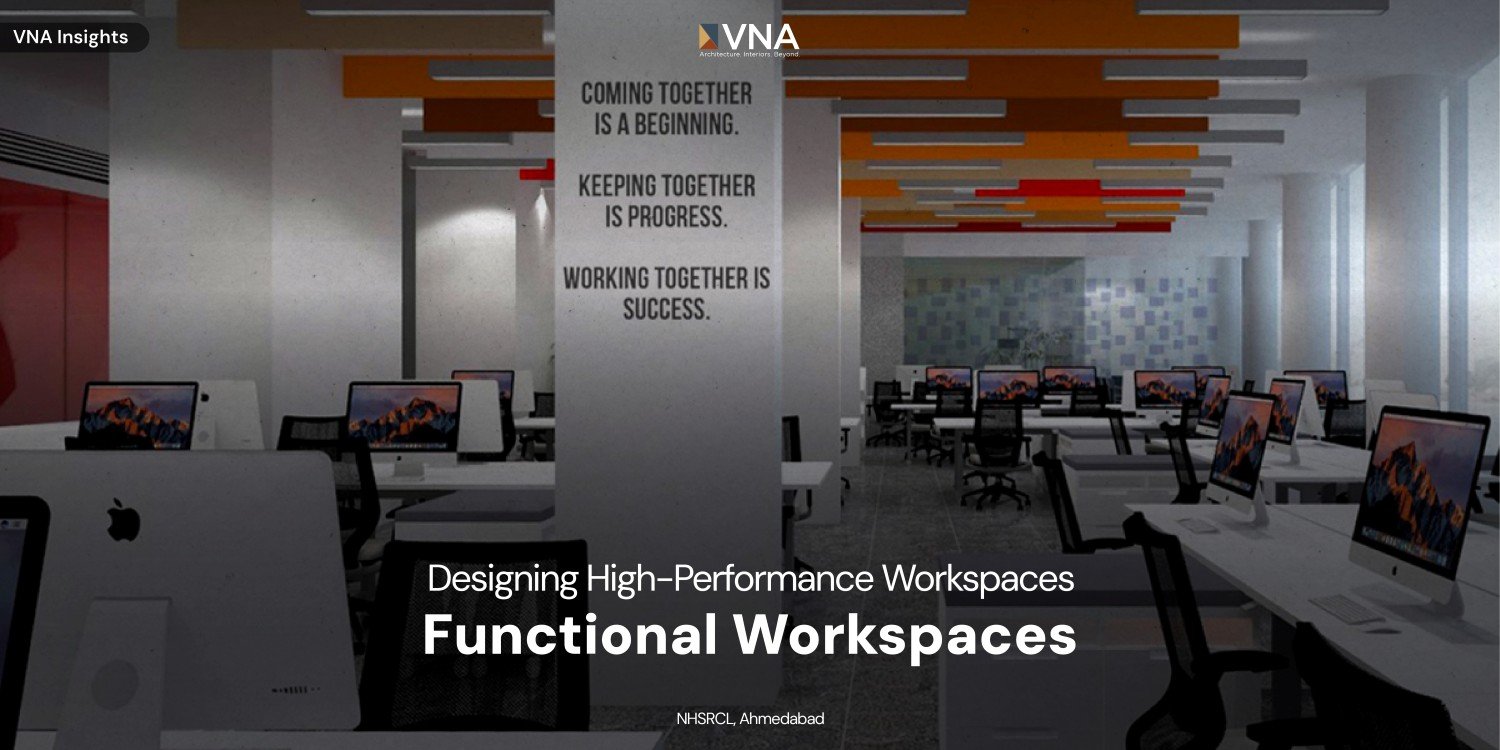
Office interiors are often judged too quickly. People walk in, register the reception, the lighting, the furniture, the colour palette—and decide whether it feels “premium.” But the true test of an office is less immediate and more unforgiving: does the place help people work without friction? This note is about interior design as infrastructure—how it shapes behaviour, productivity, and fatigue—especially now, when the office is no longer the default container for work.
A functional workspace is not one where people look busy. It is one where they waste less time being interrupted by the space itself.
What does “functional” really mean in an office?
Function is usually reduced to adjacency: cabins here, meeting rooms there, pantry there. But in practice, function is behavioural: Can I focus without performing focus? Can I collaborate without booking theatre? Can I take a call without apologising? Can I move through the floor without constantly negotiating people? Does the environment reduce fatigue—or create it?
If the space forces people to invent workarounds, the interior design has already failed.
Why do many office interiors look good and still work poorly?
Because they were designed as images.
A fashionable open plan can become an acoustic soup. A sleek meeting room can become unusable because the screen glare is wrong. A “collaboration zone” can become a passageway because circulation wasn’t respected. A reception can be beautiful and still feel like an airport check-in because arrival wasn’t designed as an experience.
Interiors are not decoration. They are operations made visible.
This connects directly to Issue 3: the office now has to deserve attendance. It can’t do that if it is exhausting.
How does interior design influence productivity without becoming controlling?
The strongest offices do something subtle: they give people choice without forcing choreography.
That means a real range of settings: quiet focus areas (not merely “no talking” signs), small rooms for calls and quick reviews, project spaces where teams can leave work-in-progress, social zones that don’t spill noise into everything, and circulation that doesn’t cut through concentrated work.
The goal isn’t to dictate behaviour. The goal is to support it.
What role do acoustics play—and why are they no longer optional?
Acoustics is one of the most ignored performance systems in office interiors—until people start avoiding the office.
In practice, acoustic comfort comes from material strategy (soft where it matters, not everywhere), ceiling and wall treatments that absorb not amplify, planning that separates high-energy zones from focus zones, and enclosed rooms distributed sensibly so privacy isn’t scarce.
An office without acoustic intelligence becomes a place where people can’t think.
Why does lighting design decide whether an office feels calm or clinical?
Most lighting problems aren’t brightness problems. They’re glare and contrast problems.
A functional office uses lighting to support screens without reflections, avoid harsh hotspots that create fatigue, provide layered light (ambient plus task plus accent), and respect daylight without letting it become glare.
Good lighting makes an office feel composed without drawing attention to itself.
What is the real job of a pantry and breakout zone?
In many Indian offices, the pantry isn’t an amenity. It’s the social engine.
A well-designed breakout zone does more than offer coffee. It creates a place where informal alignment happens—without consuming meeting rooms and without turning corridors into gathering spots.
But these spaces must be planned with care: if the pantry is placed where its energy spills into focus zones, the floor becomes noisy. If it’s hidden like an afterthought, the office becomes sterile.
How should interior design respond to hybrid work?
Hybrid work changed utilisation patterns. People come in for collaboration, mentoring, culture—less for solitary tasks. But they still need focus sometimes, especially when commuting has already consumed energy.
So hybrid interiors need both: more collaboration settings, distributed and varied, and more pockets of privacy than older offices assumed.
The trend isn’t only more meeting rooms. It’s better variety and smarter distribution.
The quiet, practical question that improves every office
Before choosing finishes, ask: Where will friction happen?
Where will people take calls? Where will noise concentrate? Where will teams gather without booking? Where will confidential conversations happen? Where will waiting happen? Where will circulation cut through work?
If interior design answers these early, the office becomes calmer. If it ignores them, the office becomes a daily negotiation.
In the next note, I’ll shift from interiors to a larger framework that affects both homes and offices: green building consulting—not as a buzzword, but as principles that improve performance, reduce regret, and make sustainability feel like common sense rather than sacrifice.
— Ar. Brijesh V Patel
Founder & Principal Architect, VastuNirman Architects (VNA)