
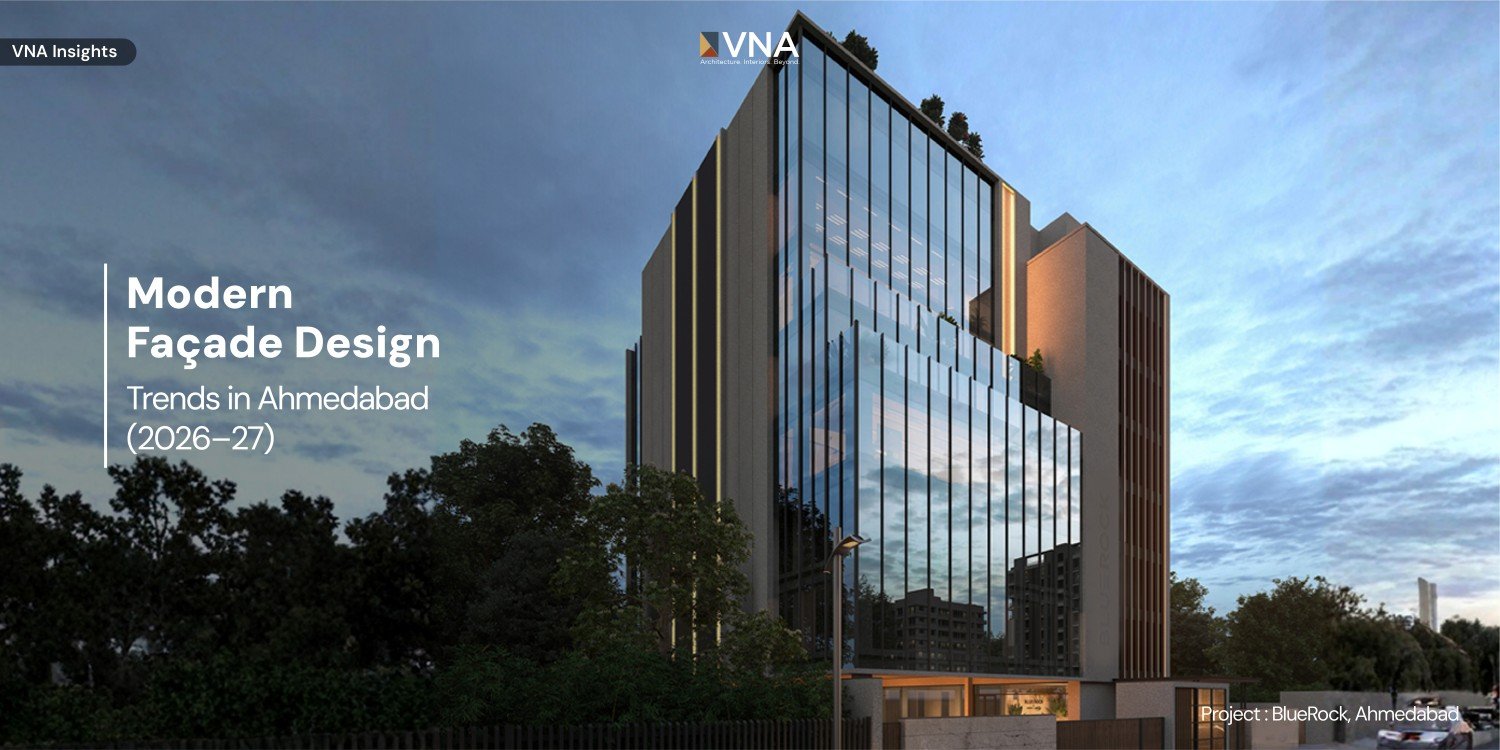
Façade trends are usually presented as material catalogues: what’s new in cladding, what colour is fashionable, what profile is being specified. This note tries something different. It looks at what is actually changing in Ahmedabad façade design—not as a style update, but as a response to climate realities, material availability, maintenance truths, and the slow maturation of local practice. The trends worth watching are not about novelty. They are about judgment catching up with ambition.
Every few years, a new façade material or technique arrives in Ahmedabad with promises: it will look modern, it will perform better, it will last. Sometimes the promises hold. Often, they don’t—because the material was tested elsewhere, in different conditions, with different maintenance cultures.
The real trends in Ahmedabad façade design are not about which panel is newest. They are about how designers and clients are learning to make better decisions—decisions that last.
What is the most important trend—and why isn’t it a material?
The most important shift is integration.
For years, façade design in commercial and high-end residential projects was often treated as a skin applied after architecture was decided. Shading was an add-on. Material choice was aesthetic. Performance was someone else’s problem.
The trend now—slowly, unevenly—is toward façades designed as systems from day one: orientation driving massing, shading integrated into form, materials chosen for climate and maintenance together.
This is not a style. It is a method. And it produces better buildings.
How is shading becoming more sophisticated?
Ahmedabad has always needed shading. What’s changing is how it’s being done.
Earlier, shading often meant applied elements: metal louvers bolted to a glass façade, chajjas added to plans late in design, screens that looked good in renders but collected dust or blocked views.
The better work now integrates shading into the façade language: recessed windows that create self-shading reveals, perforated screens that are part of the wall rather than in front of it, balconies and terraces positioned to shade the floors below, and orientation decisions that reduce the need for shading in the first place.
This connects to what I wrote in Issue 5: shading is not apology. It is design.
What materials are gaining ground—and why?
The honest answer: no single material has “won.” What’s changing is how materials are being evaluated.
Exposed concrete and fair-faced finishes are being used more confidently—not as economy, but as intention. When detailed well, they age gracefully in Ahmedabad’s climate and require less rescue than many “premium” claddings.
Brick and stone remain relevant, especially where thermal mass helps and where local sourcing reduces cost and embodied energy. The trend is toward using them honestly—not as veneer, but as structure or at least as substantial cladding.
Metal cladding and composite panels continue in commercial work, but with more caution. The failures of the last decade—staining, warping, poor detailing—are teaching harder lessons. Specification is getting more serious; installation supervision is getting more demanding.
Glass is being used more strategically. The fully glazed façade is no longer seen as automatically modern. The trend is toward glass where it earns its place—for view, for daylight, for connection—and solid wall or shaded glass where exposure demands protection.
How is climate response becoming a selling point?
For years, climate-responsive design was either assumed (everyone needs shade) or dismissed (air-conditioning solves everything).
Now, especially in commercial projects, climate response is entering conversations with clients and investors. Lower cooling loads mean lower operating costs. Better comfort means better tenant retention. Façades that perform well become part of the value proposition.
This is not yet universal. But it is growing—and it shifts façade design from a cost centre to a performance asset.
What is changing in residential façade thinking?
In homes, the trends are quieter but real.
Clients are asking more questions about west-facing glazing, about what the façade will feel like inside, about maintenance realities for different finishes. They are less seduced by render images and more concerned with how the building will perform in May.
The result is more nuanced residential façades: shaded balconies, deeper window reveals, material palettes chosen for durability, and less glass where glass would create problems.
This connects to Issue 6: the broader shift toward homes designed for real life, not ideal images.
What mistakes are still being made?
Trends are not evenly distributed. Plenty of new façades in Ahmedabad still repeat old mistakes: glass where shade is needed, materials chosen for novelty rather than climate, details that will trap dust and leak in monsoon, shading added as afterthought or abandoned as cost-cutting, and imported aesthetics that ignore local conditions.
The gap between the best new work and the average is wide. The trend is toward closing that gap—but slowly.
What should clients and designers watch for in 2026–27?
Watch for integration—façades that are designed as systems, not applied as surfaces. Watch for honesty—materials chosen for how they age, not just how they render. Watch for shading that is designed, not added. Watch for detail—junctions, drainage, thresholds, maintenance access. And watch for local intelligence—façades that belong to Ahmedabad, not to a global catalogue.
The deeper point: the best façade trend is seriousness
At VNA, we see the real trend as maturation. More clients asking better questions. More designers taking climate seriously from day one. More willingness to choose materials that last over materials that impress.
The façades that will define Ahmedabad in the next decade won’t be the loudest ones. They will be the ones that still look calm and work well in ten years—because they were designed for this city, not despite it.
This concludes Volume 3 of the series. Future notes may return to thresholds and entries, to planning principles, or to the small decisions that add up to architecture. The thread remains the same: good buildings are not about style. They are about decision-making—made visible, over time.
— Ar. Brijesh V Patel
Founder & Principal Architect, VastuNirman Architects (VNA)