
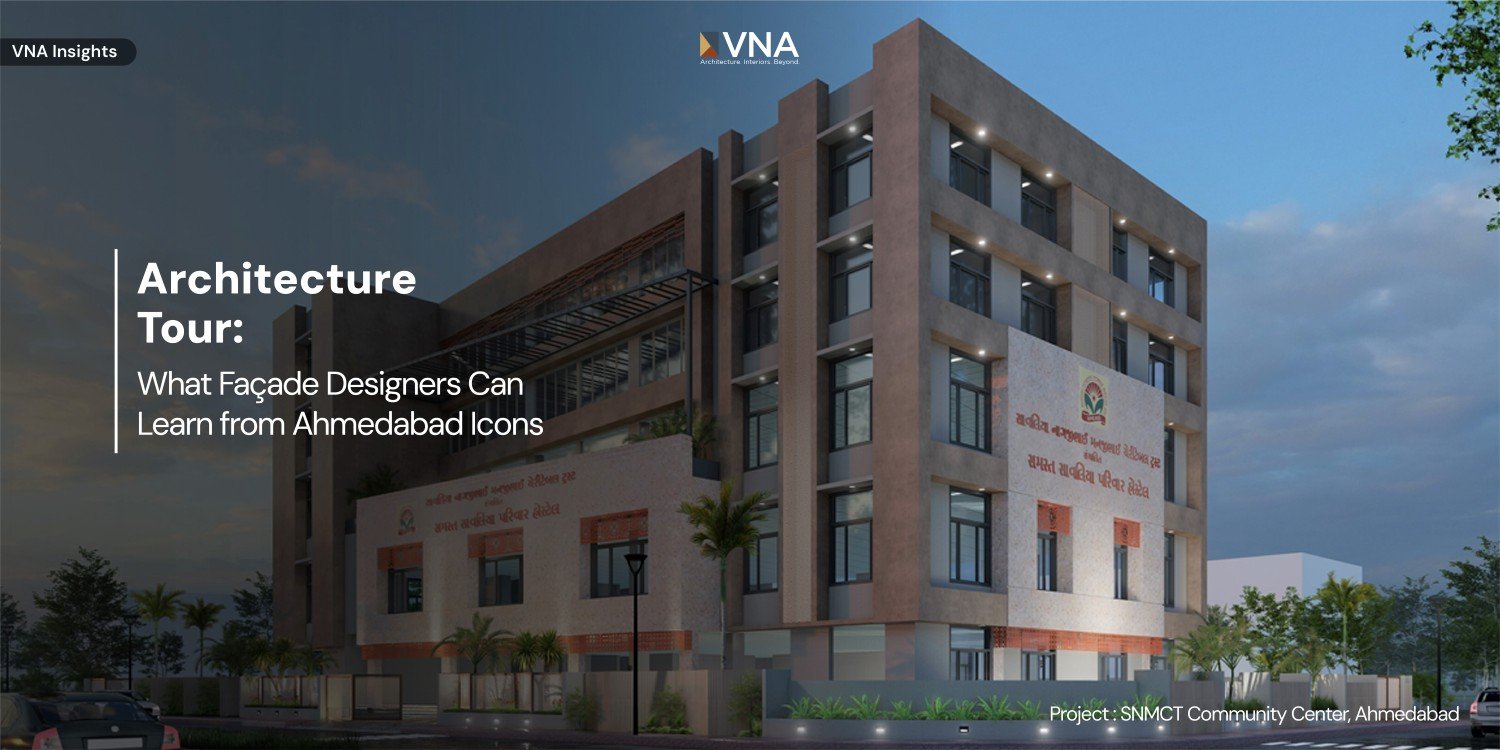
Every city teaches architecture, but Ahmedabad teaches it more insistently than most. The climate is unforgiving, the institutional legacy is serious, and the best buildings here have always treated the façade not as a canvas for expression but as a negotiation with sun, dust, and rain. This note is a walking tour of sorts—a look at what Ahmedabad’s iconic buildings can teach anyone designing façades in this city today, whether for homes, offices, or institutions.
When architects visit Ahmedabad, they often come for the modernist landmarks: the IIM campus, CEPT, the Mill Owner’s Association Building. These are pilgrimage sites, and rightly so.
But the lessons they offer are not only historical. They are operational. These buildings work—in this climate, with this light, through decades of dust and monsoon. And they work because their designers treated the façade as a serious problem, not a styling opportunity.
What does Ahmedabad’s climate demand of a façade?
Before looking at any building, remember the conditions. Ahmedabad has extreme summer heat, intense western sun, dust that settles on every surface, monsoon rain that comes sideways, and glare that punishes unshaded glass.
Any façade that ignores these conditions will either fail visibly (staining, cracking, heat damage) or fail invisibly (discomfort, high cooling loads, premature ageing).
This is why Ahmedabad’s best buildings are not “beautiful despite the climate.” They are beautiful because of how they respond to it.
What can we learn from the deep shade of the IIM Ahmedabad campus?
Louis Kahn’s IIM campus is often photographed for its geometry and brick. But its real lesson is shade.
The buildings use deep recesses, perforated screens, and careful orientation to create layers of protection from the sun. Light enters indirectly. Corridors are shaded. Openings are sized and placed to admit light without admitting glare.
The façade is not a surface. It is a series of thresholds—each one mediating between inside and outside, between direct sun and usable light.
Lesson: depth is not a luxury. It is a strategy. Shallow façades in Ahmedabad work harder and age faster.
What does CEPT University teach about breathing buildings?
CEPT, designed by B.V. Doshi, is a campus that refuses to be fully sealed. Corridors are open. Staircases are external. Courtyards punctuate the plan.
The façades here are porous. They allow air movement, create cross-ventilation, and blur the line between inside and outside. This is not nostalgia for a pre-air-conditioned world. It is climate intelligence—an acknowledgment that in Ahmedabad, buildings can breathe for much of the year if designed to do so.
Lesson: a sealed building is not automatically more comfortable. Sometimes the façade’s job is to open, not close.
What does the Mill Owner’s Association Building reveal about proportion and shadow?
Le Corbusier’s MOA Building is a masterclass in brise-soleil—the sun-breaker. The west façade, facing the harshest light, is protected by a deep concrete grid that creates permanent shade while allowing views and ventilation.
The proportions are precise. The depth of the brise-soleil is calculated to block direct sun at the angles that matter. The result is a façade that photographs as sculpture but functions as climate control.
Lesson: shading is not decoration. It is geometry. And in Ahmedabad, it should be designed with the same seriousness as structure.
What do the traditional pols teach about urban façades?
Before the modernists arrived, Ahmedabad already had centuries of façade intelligence in its old city pols.
These dense neighbourhoods use narrow streets, overhanging upper floors, deep wooden balconies, and shared courtyards to create shade at the urban scale. Individual buildings are modest, but together they create a microclimate—cooler streets, protected thresholds, and privacy without isolation.
Lesson: the façade is not only the building’s responsibility. It is part of an urban system. Even in new developments, thinking about how buildings shade each other—and the street—is good design.
What do newer Ahmedabad buildings get right—and wrong?
Contemporary Ahmedabad has produced buildings that continue this intelligence—and buildings that ignore it entirely.
The best new work uses local materials thoughtfully, integrates shading into the façade language, respects maintenance realities, and resists the temptation to import glass-curtain-wall aesthetics that belong elsewhere.
The worst new work treats façades as images: glass towers that overheat, composite panels that stain within months, details that trap dust and leak in monsoon, and shading added as an afterthought—if at all.
Lesson: contemporary does not mean placeless. The best new façades in Ahmedabad learn from the old ones—not in style, but in strategy.
What questions should any Ahmedabad façade answer?
Whether designing a home, an office, or an institution, ask: How does this façade handle the west sun? Where is the shade—and is it deep enough? How will this surface look after dust and rain? What happens when it needs cleaning or repair? Does this belong to Ahmedabad—or could it be anywhere?
The icons of this city answered these questions with conviction. New buildings can do the same.
The deeper point: Ahmedabad’s buildings are a curriculum
At VNA, we treat the city’s best buildings as teachers. Not because we copy them, but because they demonstrate what is possible when façade design is taken seriously—as climate response, as urban contribution, and as architecture that lasts.
The lessons are here. The question is whether we are paying attention.
In the next note, I’ll stay with façades in Ahmedabad but look forward: the trends shaping new work in 2026–27, and how climate, materials, and local practice are evolving together.
— Ar. Brijesh V Patel
Founder & Principal Architect, VastuNirman Architects (VNA)