
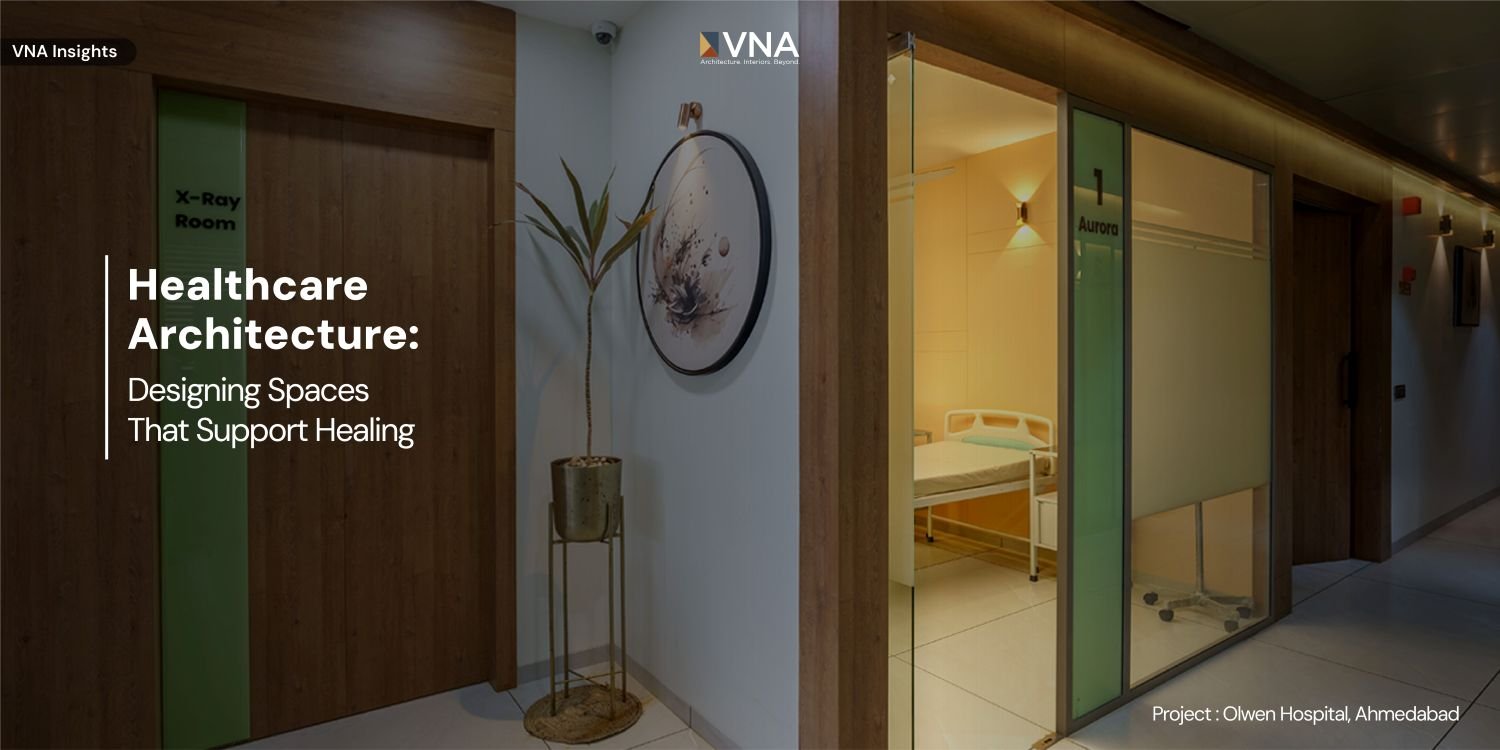
Healthcare buildings are often discussed as if they were logistics problems: patient flow, bed counts, equipment access, infection control. These things matter enormously. But they are not the whole story. A hospital or clinic is also a place where people arrive frightened, wait anxiously, receive difficult news, and—if the building is designed well—feel held rather than processed. This note is about healthcare architecture as a design discipline where operational efficiency and human dignity must coexist, and where getting the balance wrong has real consequences.
When someone searches for a “healthcare architecture firm”, they are usually looking for technical competence: someone who understands codes, patient flows, infection control, and medical equipment. That’s the baseline.
But the better question is: can this firm design a building that works perfectly and still feels humane? Because healthcare buildings that optimise only for efficiency often feel like machines—and machines are not what people need when they are unwell.
What makes healthcare architecture different from other building types?
Healthcare buildings must serve three masters simultaneously: clinical function, operational efficiency, and human experience. Most building types can prioritise one. Healthcare cannot.
A hospital must move patients, staff, equipment, and supplies with precision. It must control infection, manage emergencies, and accommodate technology that changes every few years. And it must do all this while caring for people who are vulnerable, anxious, and often in pain.
The architecture cannot choose between these demands. It must resolve them.
Why does “healing environment” mean more than aesthetics?
The phrase “healing environment” is sometimes dismissed as soft language. It isn’t.
Research consistently shows that the physical environment affects patient outcomes: access to natural light can shorten recovery times; views of nature reduce stress and pain perception; noise control affects sleep, which affects healing; wayfinding clarity reduces anxiety; and single-patient rooms reduce infection rates and improve rest.
These are not amenities. They are clinical interventions delivered through architecture.
A hospital that ignores the healing environment is not being “practical.” It is being incomplete.
How should patient flow be designed—and why is separation so important?
In healthcare, circulation is not just about efficiency. It is about separation.
Patients, visitors, staff, clean supplies, soiled materials, and emergency traffic all need distinct paths. When these paths cross unnecessarily, the building creates friction, infection risk, and confusion.
Good healthcare planning treats circulation as infrastructure: public corridors that are intuitive and calm; staff corridors that are efficient and private; service routes that are invisible to patients; and emergency paths that never conflict with routine movement.
This connects to what I wrote in Issue 2 about commercial buildings being “choreography under rules.” Healthcare is the most demanding version of that choreography.
What role does natural light play in healthcare design?
Natural light is not decoration in a hospital. It is therapy.
Patient rooms with daylight and views have measurable benefits: reduced need for pain medication, shorter stays, better sleep cycles, and improved mood. Staff areas with natural light have lower burnout rates.
But healthcare buildings also have constraints: infection control, equipment placement, privacy, and orientation. The skill is in resolving these—bringing light where it heals without compromising function.
In Indian conditions, this also means controlling glare and heat. A west-facing patient room with unshaded glass is not “bright.” It is uncomfortable. The same principles from façade design apply here.
How do you design for infection control without making spaces feel clinical?
Infection control drives many healthcare design decisions: hard surfaces, seamless flooring, hands-free fixtures, air pressure differentials, material choices. These are non-negotiable.
But clinical doesn’t have to mean cold. Warmth can come from proportion, light quality, ceiling height, colour temperature, and the few soft materials that are permitted. A waiting area can be cleanable and still feel welcoming. A patient room can meet every infection control standard and still feel like a room, not a cell.
The difference is usually in the details: the way light enters, the view from the bed, the materials at touch height, the absence of glare, and the presence of quiet.
Why is flexibility so important in healthcare buildings?
Medical technology changes faster than buildings. A hospital designed today must accommodate equipment, procedures, and care models that don’t yet exist.
Flexibility means structural grids that allow reconfiguration; service spines that can be upgraded; room sizes that accommodate multiple uses; and infrastructure capacity that exceeds current demand.
The most resilient healthcare buildings are designed as frameworks, not fixed solutions.
What about smaller healthcare facilities—clinics, diagnostic centres, wellness centres?
Not all healthcare architecture is hospitals. Clinics, diagnostic centres, day-surgery facilities, and wellness centres have their own logic—often with tighter budgets and smaller footprints.
The principles remain: clear circulation, intuitive wayfinding, appropriate separation, natural light where possible, acoustic privacy, and an arrival experience that reduces rather than amplifies anxiety.
In smaller facilities, the waiting area often sets the entire tone. A cramped, noisy, poorly lit waiting room tells patients what to expect. A calm, considered one does the same.
What should clients ask when commissioning healthcare architecture?
Ask about experience: not just “have you done hospitals” but “how do you balance clinical requirements with patient experience?” Ask to visit completed projects and speak with operators, not just owners.
Ask about process: how do you coordinate with medical planners, infection control consultants, and equipment suppliers? How do you handle the regulatory environment?
And ask about what can’t be measured: how do your buildings feel to patients? To staff? To families waiting for news?
The deeper point: healthcare architecture is ethics made spatial
A healthcare building is where a society’s values become visible. It is where we decide whether efficiency and dignity can coexist, whether healing includes the spirit as well as the body, and whether architecture can serve people at their most vulnerable.
At VNA, we believe it can. But only if design begins with that responsibility—not as an afterthought, but as the brief.
In the next note, I’ll return to Ahmedabad and to façades—but through a different lens: what the city’s iconic buildings can teach anyone designing here today.
— Ar. Brijesh V Patel
Founder & Principal Architect, VastuNirman Architects (VNA)