
A Founder’s Note
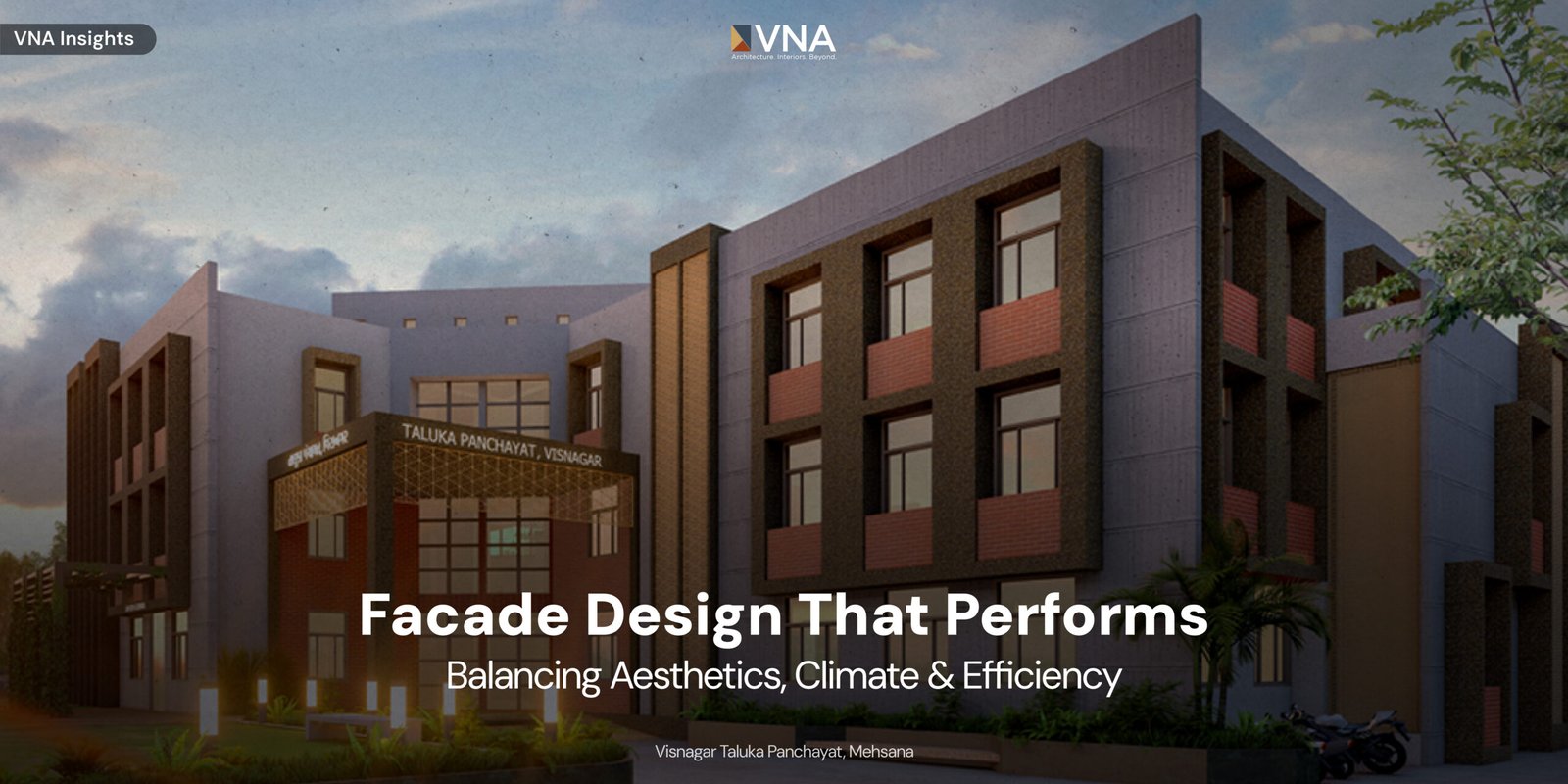
In the earlier notes, I wrote about choosing the right architect, about the difference between residential and commercial responsibility, about why offices are changing, and about how Ahmedabad’s conditions shape what good practice looks like. This next note continues the same thread, but focuses on the part of a building that attracts the most attention—and is often understood the least: the façade. The façade is not a “skin” you put on at the end. It is a decision you live with for decades.
When people talk about façades, they usually start with beauty. That’s not wrong. A façade is the most public sentence a building writes. It tells the street what kind of building it is, and what kind of care it has received.
But in practice, the façade is never only aesthetic. It is performance, maintenance, comfort, energy, durability, and—especially in cities like ours—damage control against heat, glare, dust, and monsoon. A façade is where your building negotiates with the climate every day.
At VastuNirman Architects (VNA), I’ve learned to treat façade design as a form of ethics: you can choose to impress the eye for a year, or you can choose to support the building for twenty-five.
What is a façade, really—an image or a system?
Most people approach façade design as a styling exercise. They collect references—glass towers, parametric screens, “modern” elevations—and assume the façade is a wrapper.
But a façade is not packaging. It is a system of decisions: how the building receives light, how it blocks heat, how it controls glare, how it breathes or seals, how it deals with rain, how it survives dust, how it ages, how it can be repaired without drama.
A façade that looks extraordinary and performs poorly isn’t architecture. It’s a photograph
Why does façade design determine comfort more than people realise?
In many buildings, discomfort is not caused by the air-conditioning or the lack of it. It’s caused by the façade.
A west-facing glass wall in Ahmedabad will teach you this quickly. By late afternoon, you’re not dealing with “sunlight.” You’re dealing with a thermal load that punishes the inside—higher cooling demand, glare that forces blinds shut, and that peculiar fatigue people feel in spaces that are bright but not comfortable.
Good façades are not bright. They are balanced.
They let in daylight without turning into a furnace. They give view without giving you glare. They allow openness without sacrificing calm.
How does façade thinking differ for residential and commercial buildings?
This links directly to Issue 2—because façades behave differently when the building’s responsibility changes.
A home façade is about privacy, softness, and everyday comfort. It has to hold intimacy: the ability to see out without being seen, to receive light without losing quiet, to allow airflow without inviting dust and noise into the living room.
A commercial façade is about systems and repetition. It must manage uniformity across floors, services integration, fire safety requirements, cleaning access, and long-term operational cost. Commercial façades fail when they are treated as pure expression and not as maintainable machinery.
This is why you can’t choose façade references the way you choose wallpaper. A façade is not décor. It’s operation.
What makes a façade “modern” in 2026?
“Modern façade design concepts” often get reduced to surface language: clean lines, large glazing, geometric patterns. But modernity, in architecture, is not a look. It is clarity.
A façade is modern when it responds to climate honestly, when it handles energy and comfort without pretending physics doesn’t exist, when it uses shading as design not as apology, when it is buildable, repairable, and maintainable, and when it ages without embarrassment.
In other words: modern is when it performs as well as it appears.
What are the key performance questions a façade must answer?
When we review façade options at VNA, the questions are not poetic. They are practical—and they prevent regret.
Solar control: How does the façade reduce direct heat gain, especially on the west and south-west? Daylight: Does it give usable light or just brightness and glare? Ventilation vs sealing: Is this a naturally ventilated strategy, a sealed strategy, or a confused mix? Rain and waterproofing: Where will water collect? Where will it seep? What will fail first? Dust and maintenance: How will this be cleaned? How often? At what cost? Thermal comfort: Will the inner surface become hot and radiate discomfort? Durability: What happens in five monsoons and ten summers? Repairability: If a panel fails, can it be replaced without dismantling the whole sentence?
A façade that cannot answer these questions is a façade that will eventually punish its owner.
Why do so many “good-looking” façades age badly?
Because they were designed as images.
Materials that photograph beautifully can age poorly if they weren’t chosen for dust, pollution, UV, and rain. Details that look minimal can become leak points. Complex profiles can become dirt traps. And façades that demand perfect execution often fail in the real world where execution is human.
This is where the Ahmedabad note (Issue 4) matters. A façade in Ahmedabad is not judged only at handover. It is judged after a summer of dust, a monsoon of sideways rain, and years of cleaning realities.
A façade that requires heroic maintenance is not sophisticated. It is fragile.
What is the relationship between façade and energy efficiency?
If you want a simple truth: the façade decides the building’s energy behaviour before the HVAC even begins to operate.
A thoughtful façade reduces cooling load by controlling heat gain. It allows daylight so artificial lighting demand drops. It can enable mixed-mode ventilation strategies where appropriate. It can reduce peak load, which has direct implications on equipment sizing and operational cost.
This isn’t “green talk.” It’s arithmetic.
And for commercial projects, this becomes a boardroom issue because energy cost is not a line item; it’s a recurring tax.
Is glazing always bad? Is solid wall always good?
No. Absolutes are for the internet.
Glazing is a tool. Solid wall is a tool. The intelligence lies in proportion, orientation, and detailing.
Large glazing can work if it is shaded, correctly specified, and integrated with a façade strategy that controls glare and heat. Solid walls can fail if they create dark interiors that need constant artificial lighting and feel oppressive.
The goal is not “more glass” or “less glass.” The goal is comfortable light and controlled heat.
What should clients ask their architect about façades?
If you want a quick diagnostic list before you approve an elevation, ask: Which orientations are we protecting most—and how? What will this façade feel like inside at 4 p.m. in May? Where will water sit during monsoon and where will it exit? How will this be cleaned, and who will clean it? What will this look like after five years? If something fails, can it be repaired without tearing the building apart? Are we choosing a façade that suits our city—or one that suits our reference folder?
These are not “extra” questions. They are the façade’s real brief.
The deeper point: façade is where a building shows whether it respects reality
A façade is the meeting point between architecture and consequence. It is where the building either acknowledges climate or pretends it doesn’t exist. It is where you decide whether your building will age with grace or demand constant rescue.
Beauty matters. But in the end, the best façades are not the loudest ones. They are the ones that feel inevitable: they belong to the building, to the climate, to the city, and to the life inside.
In the next note, I’ll shift from the building’s edge to its heart—residential trends that are reshaping how homes absorb real life, not ideal life.
— Ar. Brijesh V Patel
Founder & Principal Architect, VastuNirman Architects (VNA)