KEY FACTS
| Service area | Gujarat (Ahmedabad, Vadodara, Surat, Rajkot and beyond), India, and Abroad |
| Specialisation | Architectural Design — feasibility-led, approvals-aware, buildable |
| Approach | Site and climate first; decisions locked at the right stage, not reopened later |
| Sectors | Commercial, Residential, Institutional, Mixed-Use, Airports & Infrastructure |
| Contact | vna.works/contact |
Architectural Design in Gujarat
1
2
3
Most projects don’t fail because the idea wasn’t ‘creative enough.’ They fail because creativity wasn’t disciplined — decisions weren’t made early about feasibility, services, approvals, and buildability.
And the first job is rarely a design job. It is a listening job. The first brief a client gives is almost never the real problem — it is a list of features, areas, and budget. The real brief is what is behind that list. Why four bedrooms? What is fixed and what is not? What does this building need to be in twelve years? The buildings that perform are the ones where the real question got asked — early, when it costs nothing to change.
At VNA, architecture is a practice that reads the site before drawing a line, designs for climate before specifying a material, and asks what a building should feel like before deciding what it should look like. That discipline — spatial, climatic, and buildable — is what we bring to every project, whether it is a mixed-use development in GIFT City, a hospital campus in Surat, or a bungalow on a 300-square-metre plot in Bopal.
Good architecture is a spatial discipline first. Everything else follows from that.
Who This Is For
| Client Type | What Drives the Project |
|---|---|
| Developers | Residential communities, mixed-use schemes, plotted development — where FAR efficiency, parking logic, and phasing decisions shape viability from day one. |
| Commercial Owners | Offices, retail, hospitality, industrial — where circulation, compliance, and operational performance matter beyond the opening photograph. |
| Institutions | Education, civic, public buildings — where stakeholder complexity, durability, and long-term usage patterns are as important as form. |
| Premium Homeowners | Bungalows and bespoke residences — where daily life, privacy, climate comfort, and the ability to age gracefully are the real brief. |
| Redevelopment Projects | Phasing, stakeholder approvals, and coordination across existing and new — where decisions made early determine what is possible later. |
| Complex Sites | Tight plots, odd geometries, access constraints, level changes — where the constraint is the design problem, and the design problem is the opportunity. |
The decisions that determine how a building performs
| The Tension | The VNA Decision |
|---|---|
| Budget realism vs. wish-list scope | Align ambition to capex band early — before design escalates into a brief that the budget cannot deliver. |
| Sellable area vs. services + compliance | Plan shafts, ducts, and fire requirements from day one — so what is sold is also what is built. |
| Parking logic vs. future bottlenecks | Solve entry, exit, and turning radii before layouts harden — a parking solution that fails at peak hour is not a solution. |
| Approvals strategy vs. redesign cycles | Integrate byelaws into planning, not after submission — every redesign loop costs time the project cannot recover. |
| Structural grid vs. spatial freedom | Coordinate the structural intent with the planning intent early — so the column does not arrive in the middle of the room. |
| Facade intent vs. climate + maintenance | Choose envelope details and materials that perform in Ahmedabad's summer and Gujarat's monsoon — and that can be cleaned and maintained without a scaffold every two years. |
| Design drawings vs. site improvisation | Resolve the junctions at drawing stage — waterproofing interfaces, service penetrations, facade corners — so the foreman is not making design decisions on site. |
How we work
Stage 1: Discovery & Feasibility
Purpose: Align the brief, the budget, and the site constraints before design begins
- Project intent, area program, and priorities confirmed
- Site constraints mapped — edges, adjacencies, access, utilities, levels, orientation
- Initial FAR/FSI feasibility and approvals pathway reviewed — risk flags surfaced early
- Sustainability and performance targets framed at inception, not retrofit
Stage 2: Concept Planning
Purpose: Explore planning directions — with spatial, climatic, and efficiency logic — before committing to one.
- 2–3 concept options with trade-offs: area efficiency, compliance, spatial quality, construction logic
- Massing, orientation, and climate response resolved at concept level — not retrofitted later
- Agreement on what the design is optimising for: area, experience, constructability, or speed
- Structural and services strategy intent framed — not left for coordination later
Stage 3: Design Development
Purpose: Convert concept into a coordinated, buildable drawing set.
- Structural grid, MEP strategy, and envelope intent coordinated — not left for site
- Approvals drawings prepared and compliance integrated — parking, access, fire at planning level
- Interior layout and finish intent integrated at planning stage, not as a downstream layer
- Coordination across consultants — clash points anticipated before they are expensive
Stage 4: Approvals & Compliance
Purpose: Prepare documentation that holds at submission — not one that returns for redesign
- Submission drawing set prepared and coordinated across disciplines
- Planning logic aligned with byelaws, setbacks, access requirements, and compliance
- Coordination notes for consultants and authority reviewers
- Redesign loops minimised by anticipating reviewer questions before submission
Stage 5: Execution Documentation
Purpose: Produce a drawing set that the contractor can build from without making design decisions.
- Architectural execution drawing set with climate-responsive detailing
- Key details package — the junctions that fail most often: waterproofing, facade interfaces, service penetrations
- Material and finish intent aligned with durability, maintenance, and Ahmedabad's climate reality
- Coordination support drawings — integration points with structure, MEP, landscape, interiors
Stage 6: Site Support
Purpose: Protect design intent through the decisions made in concrete, not on paper.
- Periodic review visits and design intent checks during construction
- RFI responses aligned to drawing intent — not handed to the foreman to interpret
- Shop drawing review support where included in scope
- Scope varies by project stage and execution model
What we deliver
- Site understanding summary and constraints map
- Area program and adjacency planning framework
- Concept planning options with spatial, climatic, and efficiency trade-offs
- Preliminary massing and spatial strategy — orientation logic included
- Circulation and parking intent where relevant
- Submission drawing set as applicable to project type and location
- Planning logic aligned with byelaws, access requirements, and compliance
- Coordination notes for consultants and authority reviewers
- Architectural execution drawing set with climate-responsive detailing
- Key details package — the junctions that fail most often: waterproofing, facade interfaces, service penetrations
- Material and finish intent aligned with durability, maintenance, and Ahmedabad's climate reality
- Coordination support drawings — integration points with structure, MEP, landscape, interiors
- Review visits and design intent checks during construction
- RFI responses and clarifications aligned to drawing intent
- Shop drawing review support where included in scope
Sector experience — and what we optimise for
Every project has junctions where the right call is not obvious. These are the seven design tensions we resolve early — but they sit downstream of an eighth, before any of them: the difference between the brief that arrives and the brief that gets built. A list of bedrooms and a budget is not a brief. The real brief is what is behind that list — and finding it is the first decision, before any of these others.
Commercial — Office / Retail / Industrial / Hospitality
Circulation clarity, compliance readiness, and operational efficiency — so the building performs beyond opening day, not just for it.
Residential — Premium Homes / Communities
Livability, privacy, climate response, and long-term maintenance — so daily life stays comfortable, not just photogenic at handover.
Mixed-Use — Residential + Retail + Shared
Stacking logic, services coordination, parking, and phasing — so the components work together during execution, not against each other.
Institutional / Public — Education / Civic
Stakeholder clarity, durability, compliance, and operational logic — because usage patterns and approvals complexity are as demanding as any design problem.
Flagship Case Studies
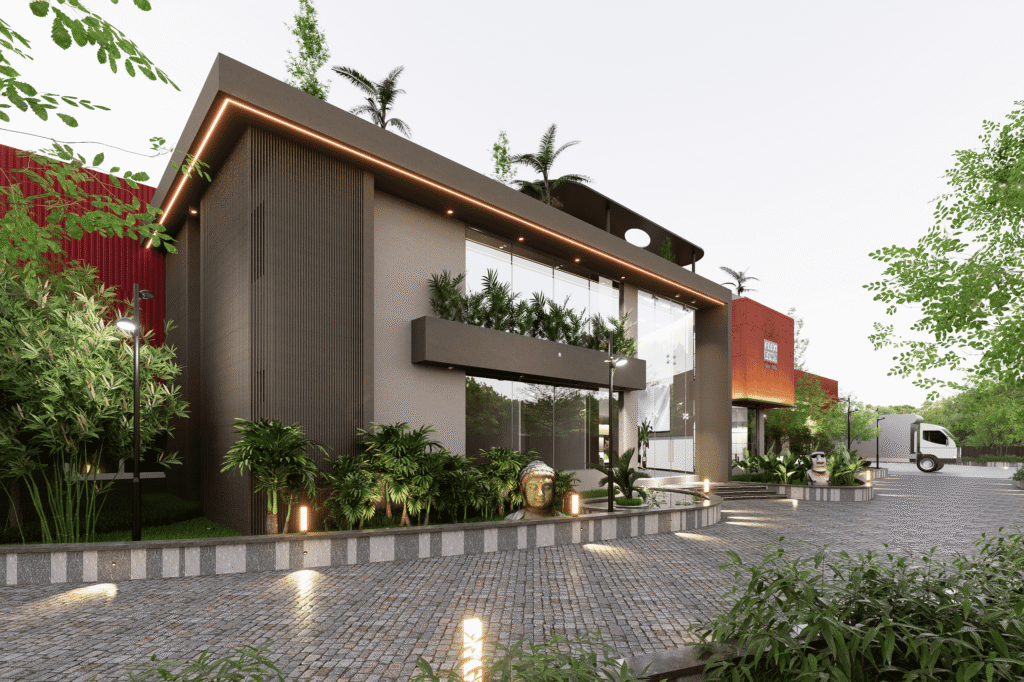
Key Decision: The façade was designed to resolve the retail-to-office transition without a visual break — floor-to-ceiling glazing at showroom level maximises street visibility for tenants, while the same glass language continues upward with shading and setback adjustments that manage Ahmedabad’s west-facing heat load at office floors, so the building reads as one composition rather than two buildings stacked.
Outcome: A commercial development where the architectural decisions directly support lease performance — showroom visibility at grade, usable green terraces that extend corporate floor area, and a building identity strong enough to anchor its location on a rapidly developing urban corridor.
Design Challenge: A 100,000 sq ft ISO-certified manufacturing facility in Kadi, Mehsana where production flow, heavy vehicle logistics, and worker environment all had to be resolved within a single site plan — without the operational requirements producing a building that looked like a generic industrial shed to visiting clients and export partners.
Key Decision: Site circulation was separated into distinct pedestrian, vehicle, and material-handling zones at the planning stage, so production operations and staff movement never conflict — while the entrance façade received the full architectural treatment that represents the client’s 28-year manufacturing credibility.
Outcome: A delivered industrial facility in North Gujarat where operational logic and building identity were designed together from the start, not traded against each other.
Key Decision: Residential and commercial access were separated at ground level from the outset, so the building could offer high street visibility for commercial tenants without compromising the privacy and arrival sequence expected by residents above.
Outcome: A delivered mixed-use building in one of Gandhinagar’s faster-growing residential corridors, where the two uses support each other’s value rather than competing for the same frontage.b
Frequently Asked Questions
Q: What does an architectural design engagement typically include?
Q: How do you charge — percentage of project cost or fixed fee?
Q: What do you need from us to start?
Q: Can you help if the approvals situation is complicated?
Q: How long does the process take?
Q: Do you coordinate with structural and MEP consultants?
Q: Will you work with our contractor?
Q: What is VNA's architectural approach?
Q: What makes VNA different from other architecture firms in Gujarat?
Q: Can you take over a project mid-way if it is stuck?
Q: Do you also work on interiors and sustainability?
Q: How do we know if our budget is realistic?
Q: Do you work across Gujarat or only in Ahmedabad?
Q: Can we see how your buildings perform after handover?
Start with feasibility. It is the first real decision.
Most buildings become operationally inefficient not at handover — but in the months and years that follow, when no one defined what ‘working correctly’ was supposed to mean.
Intelligent systems work when goals are clear, integration is coordinated, and handover is planned.
What to share before the call
- Site plan or plot details and location
- FAR/FSI and known setback constraints
- Project type and area program
- Timeline expectations
- Budget band — even a range is useful
- Reference projects if you have them — we will translate them into buildable decisions
We reply within 48 hours with feasibility questions and a suggested next-step plan.
Message us on WhatsApp